By Abel W. Sugebo
An open-source review of 17 claims, English and Arabic news coverage and 89 X posts separates what the public record shows about the UAE’s role in the Horn of Africa from what circulates about it.
On November 18, the Atlantic Council’s Africa Center held a panel in Washington titled “The risk of ignoring the Horn of Africa’s humanitarian crises.” The author was in the audience. The organizers laid out what is at stake: renewed war in Ethiopia, genocide and ethnic cleansing in Sudan, fighting in South Sudan ahead of December’s elections, and a drought in Somalia that has lasted several seasons. Citing the World Health Organization, they said more than 37.8 million people in the region face acute food insecurity and 4.9 million children are projected to suffer acute malnutrition.
Daniel P. Sullivan, Refugees International’s director for Africa, Asia and the Middle East, went further. Any effort to manage the region’s humanitarian emergency, he argued, should include calling out the role of the United Arab Emirates. His organization has made the same case in writing, urging governments to stop supporting Sudan’s warring parties and naming the UAE’s arming of the Rapid Support Forces (RSF).
Doing that well means knowing what the record actually shows. Of 17 claims about the UAE’s role in the Horn of Africa, eight are established by public evidence and seven are unproven. Every established claim of military support for a warring party concerns the RSF in Sudan. Every claim of UAE military involvement in Ethiopia remains unproven.
This analysis tested each claim against investigations, UN and court records, sanctions notices and platform takedown reports. It also measured how the claims circulate: in headlines naming the UAE across six topic searches of English and Arabic news, and in 89 X posts in five languages. Where the UAE denies a claim, the denial is noted; a denial alone does not change the verdict.
The 17 claims at a glance
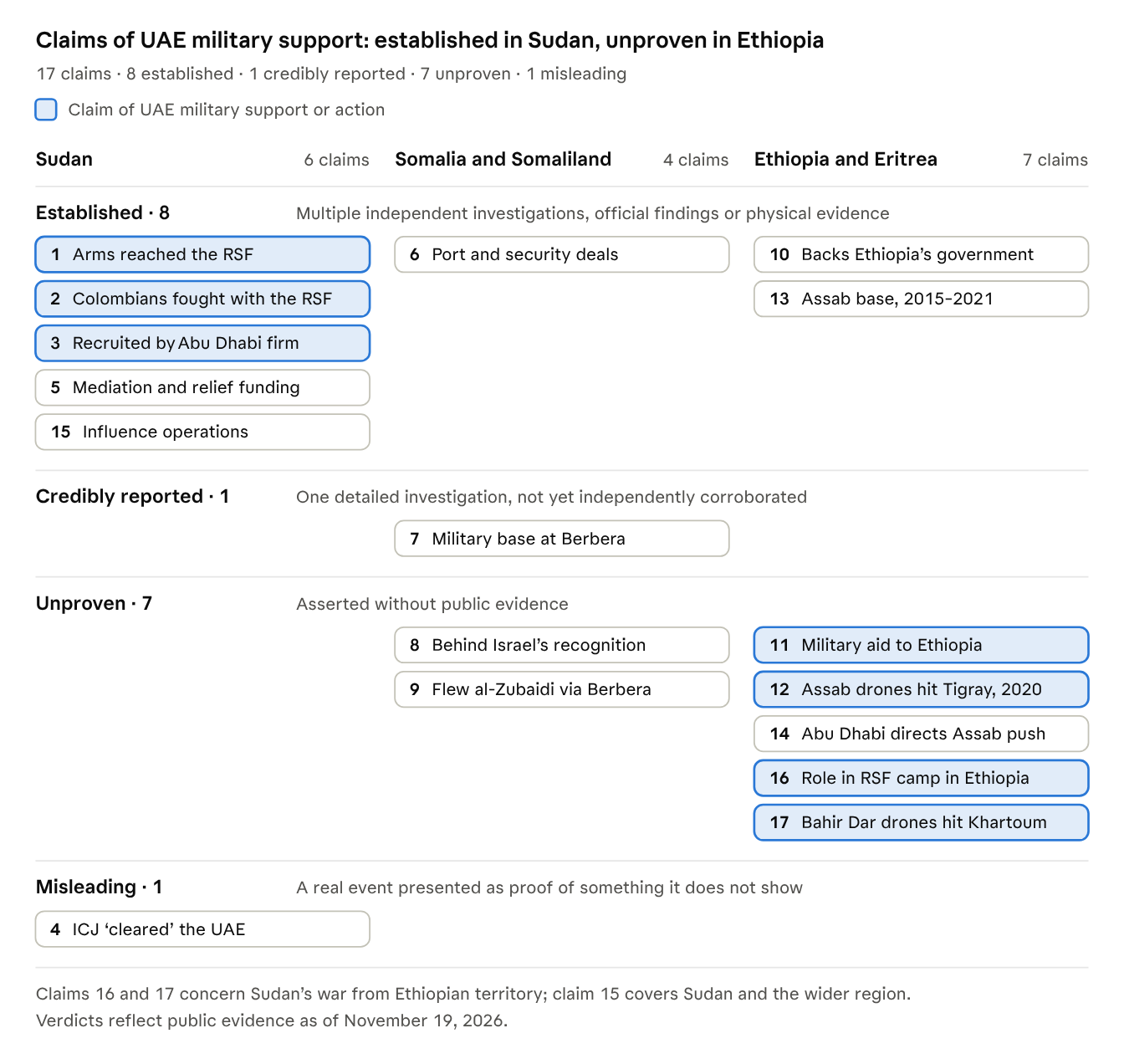
Each tile is one claim, placed by verdict and by where it applies. The full report gives the wording, evidence and sources for each.
What the record establishes
The strongest record concerns arms reaching the RSF in breach of the Darfur arms embargo. In May 2025, Amnesty International traced Chinese-made GB50A bombs and AH-4 howitzers to UAE re-export. In September 2026, the UN Fact-Finding Mission found evidence linking UAE-based individuals and entities to arms supplies for the RSF.
A UN panel of experts also found reports of UAE supply flights credible, and the US Treasury sanctioned seven UAE-based, RSF-owned companies for procuring weapons. The UAE denies arming the RSF and says the seven firms do not operate in the country.
Colombian contractors fought alongside the RSF, including in the assault on El Fasher. Human Rights Watch placed recruits at the UAE’s Ghiyathi and Al Wathba bases, citing corporate records, leaked emails and interviews. A draft UN Panel of Experts report, reviewed by Reuters, found that a UAE-based firm, Global Security Services Group, hired them.
The UN Fact-Finding Mission estimated that 350 to 2,000 Colombians were deployed to operate drones and train RSF fighters. The UAE rejects the allegations as a “false media campaign.”
In Somalia, the UAE holds port and security agreements with Somaliland, Puntland and Jubbaland, including DP World’s 30-year concession at Berbera. Somalia’s federal government annulled all UAE agreements on January 12, 2026, a decision the three regional authorities rejected. On November 19, it ordered the UAE ambassador to leave within 72 hours, citing violations of its sovereignty.
One claim is credibly reported but not yet established: that the UAE operates a military base at Berbera. Le Monde, citing satellite imagery and two sources, reported UAE-led construction at the airport since October 2025, including underground storage for ammunition and fuel. The UAE has not acknowledged a base.
The rest of the established record is diplomatic, historical or informational. The UAE sits in the US-led Quad on Sudan and pledged $500 million to a UN fund for Sudan in February 2026. Sudan’s government rejects its place in the Quad.
In September 2026, the UAE condemned attacks by the Tigray People’s Liberation Front (TPLF) and expressed solidarity with Ethiopia’s federal government. From 2015 it ran a military base at Assab, Eritrea, for the Yemen war; satellite imagery showed it being dismantled in early 2021.
UAE-linked networks have also run influence operations. In 2019, Meta removed a network tied to UAE and Egyptian marketing firms that targeted Sudan, among others, and promoted Somaliland independence. In September 2026, the AI company Anthropic linked an operation targeting UN experts on Sudan to UAE government officials, with high confidence.
What remains unproven or misleading
Unproven does not mean false. It means a claim has been made but the public record does not yet confirm or rule it out.
Claims of UAE military involvement in Ethiopia rest on assessments and accusations rather than documents. The Soufan Center assessed in August 2026 that the UAE gives Ethiopia military assistance, but neither it nor Al Jazeera’s October review documents specific transfers.
A TPLF official alleged in November 2020 that UAE drones based at Assab struck Tigray, offering no evidence. Satellite analysis by the Dutch peace organization PAX confirmed UAE Wing Loong II drones at Assab but found no indication they flew in Ethiopia.
Two unproven claims tie Ethiopian territory to the UAE’s role in Sudan’s war. The first concerns an RSF training camp in Benishangul-Gumuz, where Reuters documented about 4,300 fighters as of early January 2026. Its sources said the UAE was involved, but Reuters could not verify that independently.
The second comes from Sudan’s army. It says that drone attacks since March 1, including the May 4 strike on Khartoum airport, were launched from Ethiopia’s Bahir Dar airport, and it ties them to the UAE. As evidence, it cites data from a drone shot down in mid-March that it links to the airport and to the UAE, and officials gave the serial number of a drone they said was Emirati property. Sudan recalled its ambassador to Ethiopia.
Ethiopia rejected the accusation and accused Sudan’s army of backing fighters linked to the TPLF. The UAE denied that an Emirati drone was used. This analysis found no independent verification of the material Sudan presented, so the claim remains open. The denials do not settle it, and neither does the accusation.
The claim that Abu Dhabi directs Ethiopia’s push for the port of Assab has been made in opinion pieces, including on the Eritrean site Awate and on Noon Post, and by Eritrea’s Ministry of Information on X. None of these sources cites documents.
Two accusations in Somalia remain unproven. The first is that the UAE facilitated Israel’s recognition of Somaliland in December 2025; the UAE has not recognized Somaliland itself. The second, first made by the Saudi-led coalition in Yemen, is that the UAE moved the separatist leader Aidarous al-Zubaidi through Berbera in January 2026.
Somalia’s president made both accusations on November 17, 2026, two days before the expulsion order. The UAE denies assisting Yemen’s separatists.
One claim is misleading: that the International Court of Justice cleared the UAE of complicity in genocide in Sudan. In May 2025 the court removed Sudan’s case for manifest lack of jurisdiction, citing a UAE reservation to the Genocide Convention. It took no position on the merits.
How the claims travel
In the news
In Media Cloud’s archive of English and Arabic online news, the largest peaks in headlines naming the UAE coincide with legal and diplomatic events. Sudan-related UAE headlines peaked at 99 in May 2025. That month the ICJ dismissed Sudan’s case, Sudan cut ties with the UAE and Amnesty published its arms tracing.
Somalia-related UAE headlines stayed below 7 a month until January 2026, when the annulment of UAE agreements drove them to 65. They reached 51 in the first 19 days of November, with the ambassador’s expulsion. Human Rights Watch’s May 2026 report on the contractors and the UN Fact-Finding Mission’s September report coincided with smaller Sudan-related rises, to 28 and 27.
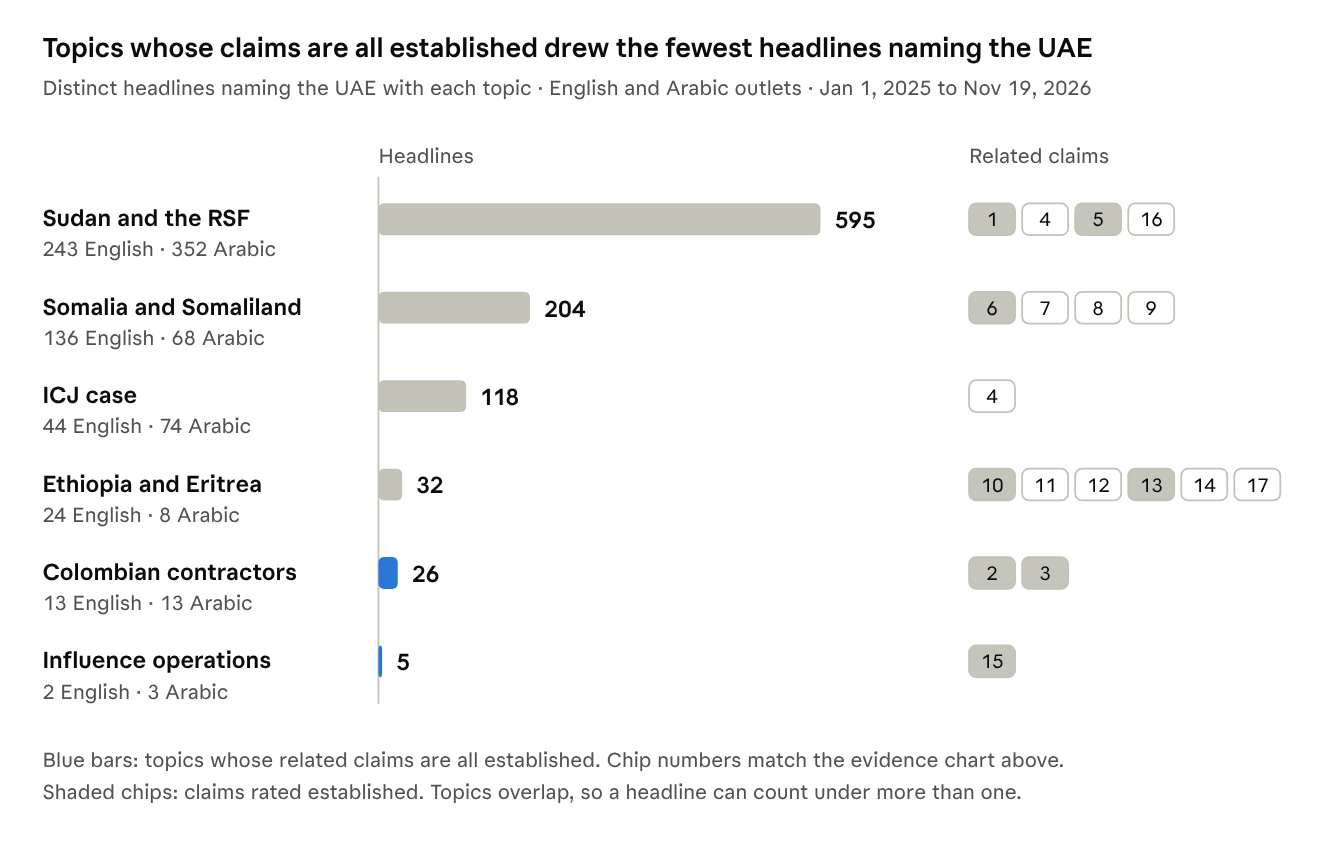
Arabic outlets carried more of the Sudan and ICJ headlines; English outlets carried twice as many Somalia headlines as Arabic ones.
On X
In the X sample, reach concentrates on the UAE side. The sample holds 89 posts with 2.8 million views, collected November 19 to 21 in English, Arabic, Somali, Amharic and Tigrinya. Posts by UAE officials and the Emirati political scientist Abdulkhaleq Abdulla drew 52 percent of those views.
Abdulla’s November 13 denial that the UAE arms the RSF drew 178,973 views. The 13 posts in the first collection round that asserted or reported the claim drew 142,612 combined.
A Somali commentator’s Arabic post gave the expulsion deadline as 24 hours; the cabinet decision gave 72. The two posts with the wrong figure drew 367,597 views, and the four with the right one drew 1,092. The sample leaves out major outlets’ accounts, which reported the correct deadline.
Arabic posts cited evidence more often, partly because that collection round targeted voices outside the UAE side. Of views on Arabic posts addressing a claim, 41 percent went to posts citing a document or investigation, against 19 percent in English.
Seventeen posts asserted that the UAE gives Ethiopia military aid, directs its push for Assab or plays a role in the RSF training camp in western Ethiopia. Seven were in English and ten in Tigrinya and Amharic; together they drew 23,479 views. None cited a document and one gave partial sourcing; two were Tigrinya posts by Eritrea’s Ministry of Information.
The X sample is purposive, not a census, and X counts impressions rather than people. No test for coordinated behavior was run on it, so none is claimed.
What remains unknown
Several questions stay open, and documents on any of them would change the picture. No document yet shows a UAE role in the RSF camp in western Ethiopia. Sudan’s evidence on the Bahir Dar drones has not been independently verified, and assessments of UAE military aid to Ethiopia cite no specific transfers.
In Somaliland, the UAE has not acknowledged the military construction reported at Berbera airport or said who would use it. No public evidence shows what part, if any, the UAE played in Israel’s recognition of Somaliland.
Anthropic’s report could not determine the reach or policy impact of the 2026 operation against UN experts. The operators of two other networks documented around Sudan’s war, in 2023 and 2025, remain unidentified.
What it adds up to
The UAE’s documented role, the subject of the call made at the Atlantic Council, lies in Sudan’s war. The accusations that extend it into Ethiopia’s wars rest, so far, on assertions without public evidence.
The UAE is not the only outside state in these wars. Turkey has supplied drones to Sudan’s army, Iran reportedly has too, and a New York Times investigation found Turkish-made drones striking the RSF from a base in Egypt.
Read the full report and data
The full report sets out the evidence and sources for each of the 17 claims. It details the news and X monitoring, checks the ten most-viewed posts and lists six documented influence operations. It also records the roles of Egypt, Turkey, Iran, Saudi Arabia, Israel and the United States in the same conflicts.
The claim register, news counts, coded X posts and scripts that recompute the main figures from those files are on GitHub. Story-level news records are not included, so the headline deduplication cannot be rerun from the repository alone. Code is released under the MIT license and data under CC BY 4.0. Private accounts are pseudonymized, and post text is not included.
How this was done
Each claim received one of five verdicts: established, credibly reported, disputed, unproven or misleading. Established means supported by multiple independent investigations, official findings or physical evidence; credibly reported means one detailed investigation, not yet corroborated. Verdicts reflect public evidence as of November 19, 2026.
News coverage was measured in Media Cloud’s English and Arabic collections from January 1, 2025 to November 19, 2026, counting distinct headlines that name the UAE within each topic search. Topics overlap, so a headline can count under more than one, and the topic totals are not a count of unique headlines. X posts were collected November 19 to 21, partly through AI-assisted searches, and each post ID was checked against the creation time it encodes.
About the author
Abel W. Sugebo is Executive Director and Founder of Inform Africa/HaqCheck, a research organization focused on disinformation, digital rights and information integrity in Sub-Saharan Africa. He has more than 12 years of experience in OSINT, influence operations analysis and investigative journalism. A co-founder of Zone Nine, Ethiopia’s pioneering digital rights blogging collective, he received the CPJ International Press Freedom Award in 2015 and works from Washington, DC.