An Inform Africa investigation examines how conflict narratives, humanitarian warnings and flawed media-monitoring data shape public understanding of five interconnected crises.
By Abel W. Sugebo | Inform Africa
Research period: October 1 to November 11, 2026
When Inform Africa searched Media Cloud’s United States – National collection for Ethiopia, Eritrea, Sudan and Somalia between October 1 and November 11, 2026, an identical block of 1,867 story IDs appeared in all four country searches. All 1,867 came from three U.S. regional news domains. Many of their headlines described sports or local community news, raising questions about whether those articles substantively discussed the countries queried.
Those same IDs accounted for approximately 57% of the Somalia search results, 74% of Sudan’s, 78% of Ethiopia’s and 92% of Eritrea’s. These are shares of raw keyword matches, not estimates of verified, relevant news coverage.
If these shared records prove incidental rather than substantive, they would inflate apparent coverage, with the largest proportional effect in the smaller result sets. But the main three-domain block could not be assessed through accessible indexed article text. The precise matching mechanism and actual relevance of those records remain unknown. We cannot infer from these counts how much meaningful coverage any country received, or whether any crisis was neglected.
A related challenge appears in the humanitarian evidence. The five country cases draw on different types of information: observed medical caseloads, provisional displacement estimates, humanitarian planning figures and conditional forecasts. In our selected Eritrea material, no directly comparable figure on humanitarian conditions inside the country was identified, while political statements were prominent.
Across the Horn of Africa and its neighboring conflict zones, humanitarian emergencies are unfolding alongside increasingly contested political and military narratives. Millions of people face hunger, displacement, disease and insecurity. Yet the information reaching the public does not always communicate the scale, nature or urgency of their suffering.
Political accusations can dominate public discussion while the needs of displaced civilians receive less prominence. Humanitarian estimates circulate without their original qualifications. Forecasts are reported as established facts. Even sophisticated media-monitoring systems can produce misleading measurements of public attention.
To examine these problems, Inform Africa conducted an exploratory media-intelligence investigation covering Ethiopia, Eritrea, Sudan, South Sudan and Somalia between October 1 and November 11, 2026. The research reviewed selected institutional statements, news reports and public social-media posts, and tested whether automated news-search data could support meaningful comparisons of media attention.
These findings do not establish that international news organizations systematically ignore the Horn of Africa. They show how selected political narratives, reused figures and unaudited media metrics can produce an incomplete picture of civilian needs. Establishing a broader pattern of neglect would require a validated comparison of substantive coverage and humanitarian severity.
Five crises, five kinds of evidence
Each case in this review is represented by a different type of evidence, alongside a politically prominent storyline in the selected material. Together, they form an evidence ladder: an observed treatment caseload in Sudan, a provisional estimate on the Ethiopia–Kenya border, planning figures in South Sudan, a forecast in Somalia and no directly comparable humanitarian estimate for civilians inside Eritrea in the records reviewed.
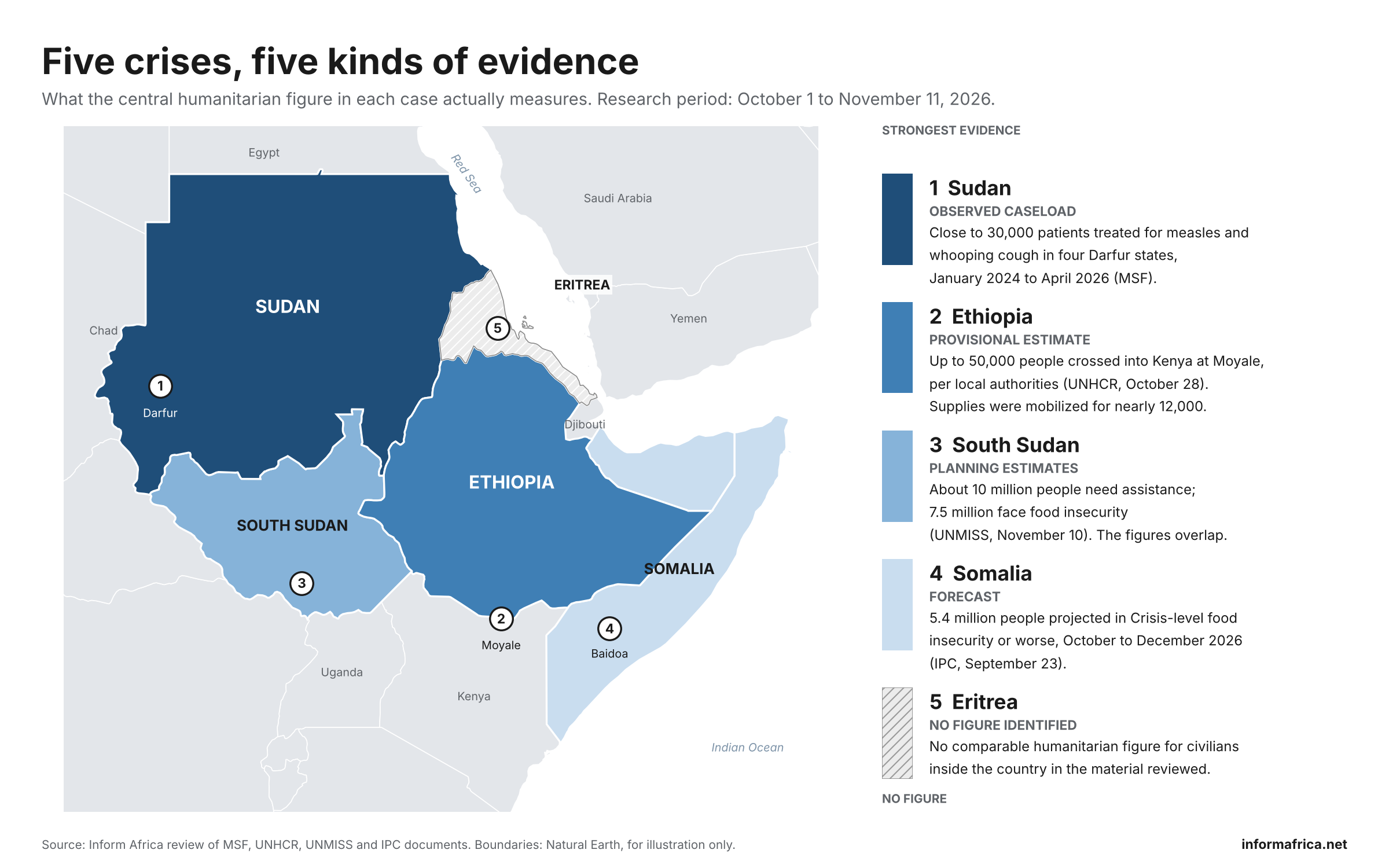
The ladder matters because those categories can be flattened in retelling: a provisional estimate may be presented as a confirmed count, a projection as an observed outcome or a multi-year caseload as a current toll.
Our purposively selected Eritrea material contained no directly comparable humanitarian figure for civilians inside the country. Three of four Eritrea-related documents in the source-discovery set were statements from Eritrea’s Ministry of Information; the fourth was a Reuters report on the diplomatic dispute. Among ten selected Eritrea-related X posts, four came from government accounts, and none was published by a humanitarian organization. These figures describe our limited source selection, not the availability of humanitarian reporting about Eritrea across the wider media landscape.
The sections below follow the ladder case by case.
Ethiopia: two emergencies that are easy to merge
Evidence: a provisional estimate. Political story beside it: a separate interstate confrontation.
On October 28, the UN Refugee Agency (UNHCR) warned of growing humanitarian needs along the Ethiopia–Kenya border. Local authorities estimated that up to 50,000 people had crossed into Kenya after clashes on the Ethiopian side of Moyale. UNHCR cautioned that registration and verification were continuing and that the situation remained fluid, meaning the estimate was provisional.
The agency was at the same time mobilizing supplies for nearly 12,000 people. That figure described an initial assistance target, not the number of people who had crossed. An estimated population movement and a response target measure different things. Treating them as interchangeable distorts assessments of both displacement and need.
The Moyale crisis is also easy to misplace. The clashes there were between Oromia and Somali regional forces, a dispute within Ethiopia that is separate both from the renewed war in the north and from the confrontation with Eritrea (Al Jazeera). As reports about Ethiopia–Eritrea tensions appeared during the same weeks, people fleeing the separate Moyale conflict risk being mistakenly folded into that different story.
For journalists and researchers, the challenge is to investigate the larger political confrontation without allowing it to absorb the civilians whose lives are already being disrupted by a different one.
Eritrea: political claims, limited civilian evidence
Evidence in this sample: no directly quantified assessment of humanitarian conditions inside Eritrea. Political story beside it: accusations of invasion and foreign sponsorship.
In the Eritrea subset of records reviewed, government and diplomatic claims predominated over independently documented information on civilian conditions inside the country. In a letter to the UN Security Council, Ethiopia accused Eritrea of an “all-out invasion,” saying its troops had advanced up to 60 kilometers into Ethiopian territory. Eritrea denied any incursion and called Ethiopia’s position a declaration of war; Reuters could not independently verify the reported incursion (Al Jazeera; Reuters). The UN Secretary-General said he was concerned by “reports of the presence of Eritrean forces” in Ethiopia, wording that records reports rather than a UN finding (UN Secretary-General’s statement).
Multilateral statements reflected concern about escalation without settling those claims. The African Union Commission’s October 1 statement urged Ethiopia, Eritrea and Egypt to show restraint. Three days later, the Commission clarified that the earlier statement was never intended to attribute responsibility for the developments under way to any neighboring state. A diplomatic appeal for de-escalation is not evidence that an organization has independently established culpability.
Similarly, the joint declaration issued after the G7 foreign ministers’ November 9–10 meeting in Paris warned that the worsening situation in the Horn of Africa risked regional escalation. It cited already dire humanitarian crises, called for the protection of civilians and unhindered humanitarian access, and noted the risks to Red Sea trade. These statements establish international concern. They do not verify the allegations advanced by the parties.
The selected documents did not provide a directly verifiable estimate of humanitarian conditions for civilians inside Eritrea. That gap is a finding about this source sample, not evidence that such information is unavailable elsewhere. It illustrates how a narrow record can emphasize official accusations without adequately explaining civilian circumstances.
Sudan: the consequences that outlast the battlefield
Evidence: an observed caseload. Political story beside it: territorial advances and accusations of foreign support.
War is frequently described through territorial advances, military operations and statements by armed actors. Some of its most devastating consequences unfold far from combat.
On November 4, Médecins Sans Frontières (MSF) reported that its teams had treated close to 30,000 patients with vaccine-preventable diseases, mostly measles and whooping cough, in MSF-supported facilities across four Darfur states between January 2024 and April 2026.
Of the five headline figures in this review, this is the only one that counts people already treated. It is not a count for October or November 2026, nor a national estimate. It is a documented caseload from MSF’s own operations over more than two years. That is precisely why it is easy to misuse: cited without its dates, a cumulative total reads like a current toll.
It nonetheless shows a critical dimension of the conflict. Disrupted immunization, damaged health infrastructure and restricted access to essential services create emergencies that persist beyond individual military events.
Our review of selected public posts also revealed contrasting emphases. Several news accounts concentrated on military developments and accusations involving armed actors. Humanitarian organizations foregrounded disease, hunger and funding shortfalls, and one news account focused on conflict-related sexual violence. These differences cannot establish which subjects dominated Sudan coverage overall; the sample was not designed to measure that. They do show how different sources can construct substantially different accounts of the same war.
A reader encountering only military updates may understand where fighting is occurring without grasping how the destruction of health services affects civilian survival. The humanitarian story is not separate from the war. It is one of the war’s central consequences.
South Sudan: overlapping emergencies require more than headline figures
Evidence: planning estimates. Political story beside it: the December 22 election.
South Sudan faces a convergence of humanitarian need, political uncertainty, violence and displacement from neighboring Sudan.
Briefing the UN Security Council on November 10, Anita Kiki Gbeho, head of the UN Mission in South Sudan (UNMISS), said that about 10 million people needed humanitarian assistance and an estimated 7.5 million faced food insecurity (remarks; briefing).
These figures describe overlapping conditions, not two populations that can be added together. They are planning estimates of need, not counts of people reached. Their significance lies in the breadth of the emergency: food insecurity exists alongside displacement, insecurity and restrictions on humanitarian operations.
South Sudan is also absorbing the effects of the war in Sudan. People arriving from across the border and those displaced by South Sudan’s own conflicts have distinct experiences and protection needs, and a single national figure does not distinguish between them.
At the political level, preparations for the planned December 22 election add further uncertainty. The existence of an electoral timetable does not demonstrate that the security and institutional conditions for credible voting have been met.
The task for humanitarian reporting is not merely to repeat the largest available number. It is to explain what each figure measures, how the emergencies interact and which groups face particular vulnerabilities.
Somalia: why a warning must not be confused with an outcome
Evidence: a forecast. Political story beside it: flood risk and shrinking funding.
Somalia shows another information-integrity challenge: communicating catastrophic risk without presenting forecasts as observed events.
An Integrated Food Security Phase Classification (IPC) analysis released on September 23 projected that 5.4 million people, 28 percent of the population analyzed, would face Crisis-level food insecurity or worse between October and December 2026. That included about 1.5 million people in Emergency conditions (IPC Phase 4). Close to 26,000 displaced people in Baidoa were projected to face Catastrophe (IPC Phase 5).
These are grave warnings, and their interpretation requires precision. The figures are projections for a defined period, not a census confirming that the projected conditions have occurred. A population group projected to face Catastrophe does not mean that an entire area has met the criteria for a Famine classification.
The IPC identified a risk of Famine for displaced people in Baidoa only under a plausible worst-case scenario, in which flooding and displacement are more severe than expected. According to the joint statement by Somalia’s government and the UN, that risk assessment rested on data collected in April 2026, with a follow-up assessment planned for October to confirm the level of risk.
Distinguishing between a forecast, a risk scenario and an observed condition does not diminish the warning. Early-warning systems are valuable precisely because they identify catastrophic outcomes before they occur. The public should understand both the severity of the projected emergency and the uncertainty inherent in forecasting it.
The problem of repeated claims
One recurring finding was that information appearing across multiple sources did not necessarily represent multiple independent confirmations.
The Moyale estimate shows how this happens. The local-authority figure of up to 50,000 cited by UNHCR on October 28 reappeared in November 7 reporting on a $3 million emergency allocation announced by UN relief chief Tom Fletcher on November 6 (People Daily). The later use of that figure does not, by itself, constitute a second independent verification of arrivals.
Somalia’s food-security projections circulated through both humanitarian and civil-society accounts, all tracing back to the same IPC analysis. South Sudan figures were repeated in institutional and commentator posts drawing on the same UN humanitarian snapshot. An account of the G7 declaration was relevant to both the Ethiopia and Eritrea cases, but it remained a single post referencing one diplomatic statement.
When several outlets repeat a claim originating from the same statement, the repetition creates an impression of corroboration even when no additional verification has occurred. The same principle applies to accusations involving foreign governments, military assistance and responsibility for violence. A public allegation is evidence that an allegation was made. It is not, by itself, proof that the alleged conduct occurred.
None of the examples examined here establishes coordinated disinformation or deliberate manipulation. They show why source independence matters as much as source quantity.
Can we reliably measure which crises receive attention?
A central objective of this research was to test whether news-monitoring data could provide a defensible comparison of attention across the five countries.
Inform Africa used Media Cloud’s United States – National collection (ID 34412234) to search country, humanitarian and security terms during the research period. The project preserved 15 attention-over-time exports, each containing 42 daily observations.
Validation exposed the problem described at the top of this article. The Ethiopia, Eritrea, Sudan and Somalia searches shared 1,883 identical story IDs. Of these, 1,867 came from three U.S. regional news domains, and many titles appeared unrelated to the countries queried. Titles alone do not establish irrelevant article content. Separately, all 133 records retrieved for South Sudan also appeared in the broader Sudan search, so these sets cannot be interpreted as independent coverage totals.
Further diagnostic testing narrowed the problem. A deliberately impossible search term returned no results, suggesting the system was not returning arbitrary records for every query. Yet single-word searches for Ethiopia and Eritrea each retrieved the entire suspicious block, while searches limited to headlines retrieved none of it. In one accessible example, country names appeared incidentally in a list of where a sports broadcast was available, rather than as the subject of the article.
The indexed article text and matched-term locations for the main three-domain block were not accessible in our audit. The precise retrieval mechanism therefore remains unresolved. The diagnostic tests do not establish a general failure of Media Cloud or demonstrate that every suspicious result was wrong. They establish that these keyword counts are not yet validated measures of substantive humanitarian coverage.
Inform Africa therefore withheld proposed country-attention rankings. The shared block represents very different proportions of the four country queries, so any effect from irrelevant matches could be uneven. Without auditing the underlying stories, however, we cannot quantify that effect or identify which crisis received less substantive reporting.
The ability to count articles does not establish the ability to measure meaningful attention. A country name appearing in a document is not a news report examining that country’s emergency. Answering questions about prominence, accuracy and reach requires validated article relevance, a defined comparison universe and appropriate measures of audience exposure.
What the findings mean for humanitarian journalism
The five-country review points to a broader problem in how humanitarian information is produced, circulated and interpreted.
First, every figure has a rung on the evidence ladder, and reporting should name it. A provisional displacement estimate, an assistance target, a cumulative caseload, a planning figure and a food-security projection are not interchangeable, and each should be reported with its source, its date and what it measures.
Second, humanitarian reporting must distinguish evidence from assertion. Statements by governments, armed actors and international institutions should be attributed accurately, with clear separation between verified observations and contested claims. Where a selected source set lacks directly verifiable civilian-impact information, as our Eritrea subset did, that limitation should be disclosed rather than filled with unverified political claims.
Third, repetition must not be mistaken for corroboration. Researchers should trace claims to their earliest identifiable source and establish whether later reporting adds independent evidence.
Finally, the tools used to measure coverage must themselves be scrutinized. Automated retrieval can support valuable research, but unvalidated keyword matches should not become the basis for conclusions about editorial neglect, in either direction.
The cost of an incomplete picture
The humanitarian crises affecting Ethiopia, Eritrea, Sudan, South Sudan and Somalia cannot be reduced to a single narrative. They involve different political circumstances, distinct civilian populations and very different degrees of documented need.
What the evidence makes clear is that serious humanitarian conditions coexist with contested accounts of responsibility. What this investigation cannot yet establish is whether those conditions receive attention proportional to their severity. That uncertainty should not weaken the case for scrutiny. It should strengthen the demand for better evidence.
For the Horn of Africa, the risk is twofold: civilian needs may be inadequately communicated, while unreliable retrieval counts may misrepresent what has been reported. This investigation identifies reasons for concern, not a quantified deficit in regional media attention.
The responsibility of journalists, researchers and information platforms is to ensure that the region’s humanitarian emergencies are neither hidden behind political narratives nor misrepresented through unreliable measurements.
About the investigation
This article draws on an exploratory Inform Africa research project covering October 1 to November 11, 2026.
The research included 24 purposively selected news and institutional records and 49 distinct public X posts, represented through 50 country-case entries, ten per country. The selected posts are not a representative sample of the platform, and the two sets were analyzed separately.
The team also conducted a Media Cloud retrieval analysis using the United States – National collection (ID 34412234), preserving the original exports and documenting subsequent validation problems. No comparative country-attention rankings are presented because the relevance of retrieved stories remains unresolved.
The methodology, code and supporting resources for this investigation are available on GitHub. Post-level and story-level records are withheld under the project’s ethics rules.
Primary institutional sources are linked throughout the article. AI-assisted tools supported the research and drafting process, with editorial responsibility retained by the author.
Inform Africa is an independent initiative focused on information integrity, media monitoring, digital rights and evidence-based public-interest research.